Digital Home Thoughts - News & Reviews for the Digital Home

Be sure to register in our forums and post your comments - we want to hear from you!


Zune Thoughts

Loading feed...

Apple Thoughts

Loading feed...

Laptop Thoughts

Loading feed...


All posts tagged "Intel"


Monday, January 19, 2009

AMD To Launch Dual-Core Neo CPU in 2009

Posted by Jason Dunn in "Digital Home News" @ 07:00 PM

http://www.dailytech.com/AMD+Will+L...rticle13992.htm

"AMD showed off a new platform at CES called Yukon that featured a new single-core Athlon Neo processor. The HP machine featuring the platform was very thin (think MacBook Air) and looked fantastic. HP is set to begin shipping the notebook in 2009. EWeek reports that AMD will also be fielding a dual-core version of its Neo processor that will be part of the Congo platform. Congo and the dual-core Neo are reportedly set to launch later in 2009. Congo will be a platform for new types of ultraportable laptops. AMD was very clear in meetings at CES that the Neo was not for the netbook market."

I haven't had a chance to benchmark the Neo CPU, but coming in at 15 watts, it's a power-hungry beast compared to the Intel Atom chip (which sips a dainty 2.4 watts under load) - yet even though it runs at the same 1.6 Ghz as the current Atom, it's said to offer more performance. The biggest difference between the Neo CPU and the Intel Atom is that the Neo CPU is paired with a nice ATI graphics solution on the HP dv2, whereas all Intel Atom-based systems I've seen are paired with the entirely useless Intel graphics solution. I like seeing Intel having competition, so I wish AMD well with this line of CPUs.
More CPU Cores Not Always Better Says Sandia

Posted by Jason Dunn in "Digital Home News" @ 04:00 PM

http://www.dailytech.com/Sandia+Say...rticle13969.htm

"The Sandia team has found that simply increasing the number of cores in a processor doesn't always improve performance, and at a point the performance actually decreases. Sandia simulations have shown that moving from dual core to four core processors offers a significant increase in performance. However, the team has found that moving from four cores to eight cores offers an insignificant performance gain. When you move from eight cores to 16 cores, the performance actually drops. Sandia team members used simulations with algorithms for deriving knowledge form large data sets for their tests. The team found that when you moved to 16 cores the performance of the system was barely as good as the performance seen with dual-cores."

First we hit the thermal/power barrier on CPUs, which had Intel and AMD moving toward a multi-core approach rather than simply racheting up the speed, and now we see that moving beyond four cores is problematic - I wonder how they'll get around that problem? Granted, the real problem with multi-core computing is still more software than hardware.


Friday, August 22, 2008

Intel Raises our Hopes with Wireless Power Prototype

Posted by Suhit Gupta in "Digital Home News" @ 04:00 PM

http://www.dailytech.com/Intel+Demo...rticle12740.htm

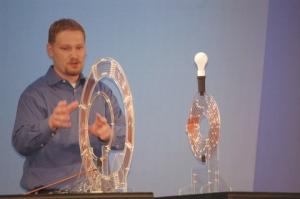
"Wireless is one of those hot tech catch-alls of the new millennium. There's wireless broadcasters and receivers, utilizing such technology as WiMax, 802.11n, and Bluetooth. There's wireless gaming controllers. There's just about wireless everything -- except power transmission. Wireless power transmission is something that inventor Nikolai Tesla came up with over a century ago and claimed to have perfected. However, his mysterious work vanished with his death, and for decades the topic was left untouched. Now there has been a resurgence in interest with several companies competing to becoming the first to offer commercially broadcast wireless power. At the Intel Developers Forum (IDF) this month, Intel demoed just such a system. Using two large coils it showcased a system that could send 60 watts of power at 75 percent efficiency up to 3 feet. The power was enough to light up a bulb at the receiving end. Justin Rattner, Intel’s chief technology officer describes, "Something like this technology could be embedded in tables and work surfaces, so as soon as you put down an appropriately equipped device it would immediately begin drawing power.""

75% efficiency is not bad at all for now. I remember reading about a real test of wireless power about 6-7 years ago in a Japanese laboratory (I think I have that right, but my memory could be going). And the article said that Japanese scientists were planning on putting an array of large satellites into space (to capture solar power) and then beam it down via microwaves. Well, this experiment from Intel seems much safer than being zapped from outer space. Anyways, it seems clear that we are years away from realistic wireless power for consumer devices, but I still sit here with bated breath.


Thursday, August 14, 2008

Now Available - USB 3.0 Specifications

Posted by Chris Gohlke in "Digital Home Hardware & Accessories" @ 10:00 PM

http://www.dailytech.com/Intel+Anno...rticle12664.htm

"Intel finally announced the availability of the draft specification for the USB 3.0 host controller. Intel dubbed the specification the Extensible Host Controller Interface (xHCI). The USB 3.0 architecture is also known as SuperSpeed USB. The USB 3.0 specification promises to increase performance by 10 times what USB 2.0 is capable of. USB 3.0 or SuperSpeed USB promises bandwidth in the 600 MB/s second range. Products utilizing USB 3.0 are expected to arrive in 2009 or 2010. USB 3.0 is also backwards compatible with USB 2.0 and USB 1.1."

As always, faster is better and 10x faster will sure make for some lightning fast data transfers. I'm curious how quickly the standard will be picked up once available. I remember jumping on USB 2.0 and installing a card to add it to my desktop and laptop so I could make quicker backups and such, but at this point, I don't know that I'd make the switch until it came built in on my next machine.

Tags: Intel, USB 3.0

Monday, August 11, 2008

Intel Reveals Nehalem Processors

Posted by Jason Dunn in "Digital Home Talk" @ 04:38 PM

http://www.dailytech.com/Intels+Nex...rticle12625.htm

"The impending launch of Intel's Nehalem processor in Q4 2008 already has the hardware community buzzing. Nehalem has already shaped up to appear quite the performance beast. With the power of eight logical cores (four physical, doubled by hyper-threading) built on a 45 nm process to leverage, it's shaping up to be a strong offering. The new processor will feature QuickPath, Intel's answer to AMD's HyperTransport, an on-chip memory controller, SSE4 instruction support, and an 8 MB cache pool. Chips have already been demoed running at 3.2 GHz, so early indications are that Intel has had relatively little process problems."

These new processors look great, but the hard truth is that even with four hyper-threaded cores rocking eight threads, unless software breaks through the current barrier of being coded for a single core (or maybe two if you're lucky), performance isn't going to go up by very much. Leveraging multiples cores matters the most when it comes to media encoding, and the problem is that most developers don't seem to be able to code their applications to take advantage of multiple cores. I've read that it's difficult to code applications to encode in parallel, but software developers have had a few years to figure this out - and I'm consistently disappointed with almost every piece of software I try. If Intel wants people be excited about their muti-core CPUs, they might need to take a few million dollars and develop a truly kick-ass multi-threaded encoder - then give it away for free so it can be adopted by all of the companies who make video editing software.


Monday, August 4, 2008

Intel's 'Larrabee' Graphics Chip is Really a Bunch of CPUs?

Posted by Jason Dunn in "Digital Home News" @ 01:00 PM

http://news.cnet.com/8301-13924_3-1...=1&tag=nefd.top

"Intel has disclosed details on a chip that will compete directly with Nvidia and ATI and may take it into unchartered technological and market-segment waters. Larrabee will be a stand-alone chip, meaning it will be very different than the low-end--but widely used--integrated graphics that Intel now offers as part of the silicon that accompanies its processors. And Larrabee will be based on the universal Intel x86 architecture."

I was wondering what Intel was up to, and it seems they're doing what Intel does best: CPU stuff. Larrabee is really going to be a bunch of CPUs on a card, and not a GPU-based solution that early speculation thought it was going to be. CPU's tend to be vastly less efficient at 3D graphics than dedicated GPUs, which is why we've seen the industry adopt dedicated GPUs as the solution of choice for 3D gaming. Intel's approach is quite interesting - one the one hand, it seems foolish to ask a CPU to do a GPU's job. Having eight CPUs on a card might be an expensive, power-hungry approach. Read more...


Wednesday, July 23, 2008

How Can AMD Beat Intel? Some Ideas

Posted by Jason Dunn in "Digital Home Articles & Resources" @ 06:56 PM

http://www.tomshardware.com/news/AM...Intel,5937.html

"Think of the Spartans at Thermopylae (the movie 300 was over the top, but makes the point): They were the best trained (highest quality) solders of their time and while they eventually got their butts kicked, they took on a vastly larger force and held them for a prolonged period. They didn't do it by going man to man; they did it by focusing on quality over quantity. You might think of this as another way of saying focus, but it is more than that. It is setting a quality mark higher than your competitor is willing to set - and making the market understand that quality. Think about it: Does Apple compete on price or do they compete on perceived quality? Often, we define products by performance, but there are other measures that are often more important. We don't, for instance, all drive cars with big V8s. Toyota beat GM and Ford not by having more cars, more lines, or more resources. They beat them by having better gas mileage and better quality at similar prices."

Man-who-is-everywhere-online Rob Enderle has a four-step plan for AMD to beat Intel. He has some good concepts, but the hard part is coming up with the product that matches the concept. It's one thing to say "focus on quality, not quantity", but it's quite another to come up with a product that's higher-quality than what Intel has to offer. One of the ways AMD could compete on quality would be to partner with a motherboard manufacturer and optimize the hell out of the board when used in conjunction with an AMD CPU. A few weeks back I swapped motherboards and put a new ASUS motherboard (an M3A78-EMH HDMI) in to partner up with my AMD 6400+ X2 CPU, and it was a complete and utter disaster - I'm still too upset to write about it. Everything worked (mostly) but the performance was atrocious. Actually, no, it was atrocious multiplied by pathetic...squared. If there was a motherboard with properly tuned chipset drivers that would work great with the AMD processor I had, I would have bought it.

Tags: Intel, AMD

Tuesday, July 22, 2008

Intel Unveils Centrino 2 Platform

Posted by Jason Dunn in "Digital Home Articles & Resources" @ 12:08 PM

http://www.anandtech.com/cpuchipset...doc.aspx?i=3356

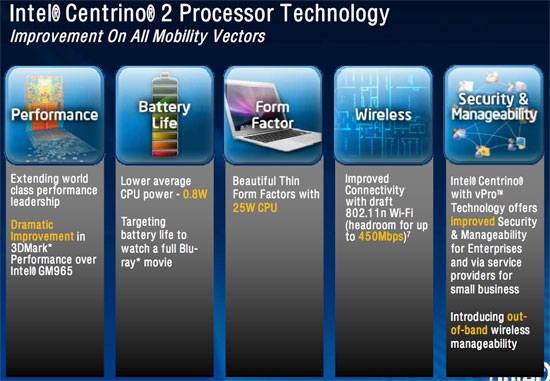
"For the first significant update to the Centrino name since it was launched in 2002, Intel really dropped the ball on actually putting substance behind today's announcement. The platform itself is what we've come to expect from Intel's mobile team, it looks to have all the right pieces and there's a good mix of innovation and steady evolution here - the problem is that we can't really even begin to test any of the interesting bits, there's hardly any hardware out there to test. We contacted HP, Dell, Gateway, ASUS and even Hypersonic (a division of OCZ) - not a single company could provide us with a Centrino 2 notebook for review. Intel blames the lack of available hardware on issues with the GM45 chipset as well as incomplete FCC certification on the new wireless adapters. Both issues have either been resolved or are in the process of being resolved, but they pushed the launch back by at least a month; Centrino 2 was supposed to debut in June."

This news came out last week, but I thought it was important enough to be worth posting on: Intel's first Centrino platform came at an ideal time, as the sales for laptops were exploding, and their branding campaign helped consumers solidify the concept of integrated wireless (and an Intel processor, naturally!). This time around, Intel has to content with AMD's Puma platform, and with the additional firepower of the ATI GPU in Puma, I'm not so sure Intel will have an easy time of it. Intel's lower-power CPUs will help them lock down most of the ultra-thin/light laptop designs though - AMD is lagging in this regard, not delivering on more power-friendly CPUs until the Shrike time frame (2009). Regardless of which platform you find more appealing, it's a great time to be a laptop-buying consumer with both Centrino 2 and Puma-based designs hitting the market over the next few months.

Tags: Intel, Centrino 2

Tuesday, June 10, 2008

AnandTech Delves Into Intel's Nehalem CPU

Posted by Jason Dunn in "Digital Home Articles & Resources" @ 11:00 AM

http://www.anandtech.com/cpuchipset...aspx?i=3326&p=1

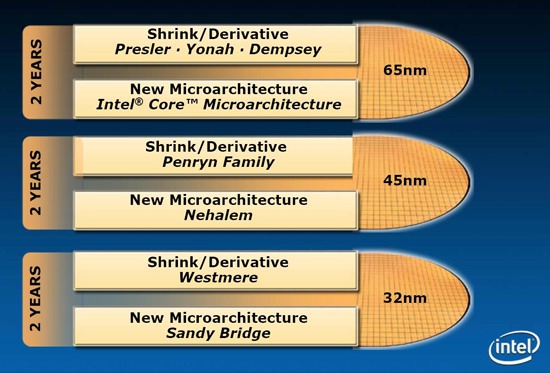
"Two years ago in Taiwan at Computex 2006 Gary Key and I stayed up all night benchmarking the Core 2 Extreme X6800, the first Core micro-architecture (Conroe core) CPU we had laid our hands on. While Intel retroactively applied its tick-tock model to previous CPU generations, it was the Core micro-architecture and the Core 2 Duo in particular that kicked it all off. At the end of last year we saw the first update to Core, the first post-Conroe "tick" if you will: Penryn. Penryn proved to be a nice upgrade to Conroe, reducing power consumption even further and giving a slight boost to performance. What Penryn didn't do however was shake the world the way Conroe did upon its launch in 2006."


Intel has had a "tick tock" strategy for years: the "tick" is a relatively minor, but still important improvement in their CPU (such as moving from 65nm down to 45nm), and the "tock" is a big leap forward (such as a new microarchitecture). Nehalem is a big step forward, and based on AnandTech's early preview, we're going to be seeing 30% to 40% improvements in a variety of areas such as media encoding. I can't wait!


Thursday, May 15, 2008

Excitement Grows for the Intel Atom

Posted by Chris Gohlke in "Digital Home Hardware & Accessories" @ 09:00 AM

http://www.cnet.com/8301-13924_1-99...ag=2547-1_3-0-5

"Intel's Atom processor was prominently displayed in systems at a conference in Japan. The chipmaker's next-generation X4500 graphics also made an appearance. Small systems and circuit boards using the Atom processor appeared on the Web site PC Watch, which highlighted designs at a "Systems Expo" in Tokyo. A host of small devices with the Atom processor are due in June. The 45-nanometer chip will compete with processors from Via Technologies such as the C7 and upcoming Isaiah processor. Small PCs and computer systems using the low-power Atom processor included a small embedded computer from Japan-based Dux, a car "infotainment" system from Portwell Japan, and a motherboard for mobile internet devices from Sophia Systems."

The market for low power processors is really heating up. There will always be the need for the fastest processors for certain applications, but for your standard functions a low power processor and efficient programs and OS's will get the job done.

Tags: Intel, Atom

Tuesday, March 18, 2008

Intel Netbook

Posted by Chris Gohlke in "Digital Home Hardware & Accessories" @ 09:00 PM

http://www.laptoplogic.com/news/detail.php?id=4597

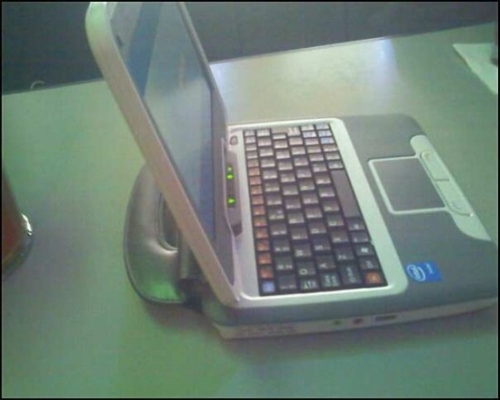
"These pics of the Netbook were reportedly taken at an undisclosed OEM facility. The preliminary specs look similar to the second-generation Eee PCs as it weighs less than 3 pounds, 900MHz Celeron M processor, 512MB RAM, WiFi, Ethernet, 40GB HDD and more importantly a 9-inch diagonally wide LCD. To make this Netbook more convenient, Intel also decided to throw in a carry handle similar to the one on Classmate PC."


While I love the competition in this space, I've got to ask, does anyone really want an UGLY handle on their machine? Manufacturers, unless it is tough enough not to need a case, please don't add a handle.

Tags: Eee, Intel, Netbook

Thursday, March 6, 2008

Is Intel Responsible for Suck-Tastic Hardware Running Vista?

Posted by Jason Dunn in "Digital Home News" @ 05:00 PM

http://arstechnica.com/news.ars/pos...soft-bends.html

"When we learned Windows Vista would come in three consumer editions, we were surprised: wasn't two enough? New evidence supports the possibility that the birth of the most controversial of these—Windows Vista Home Basic—was rooted in an attempt to sell aging hardware and survive yet another holiday season without a new release of Windows. while this remain just a hypothesis for now, it is clear that Microsoft made compromises to what it considered the minimum specifications for full Vista support in order to accommodate Intel."

An interesting article about Intel pressuring Microsoft to loosen their hardware requirements for Windows Vista, which resulted in a lot of computers running Vista that probably shouldn't have. And then people wonder why Vista is "so slow" on their designed-for-XP hardware...


Featured Product

The Canon PowerShot S100 - The incredibly fun and small camera that offers you 12.1 megapixels with a bright f/2.0 lens and full 1080p video recording . MORE INFO

News Tip or Feedback?

Contact us

Thoughts Media Sites

Windows Phone Thoughts

Digital Home Thoughts

Zune Thoughts

Apple Thoughts

Laptop Thoughts

Android Thoughts

Reviews & Articles

Loading feed...

News

Loading feed...

Reviews & Articles

Loading feed...

News

Loading feed...

Reviews & Articles

Loading feed...

News

Loading feed...

Reviews & Articles

Loading feed...

News

Loading feed...

Reviews & Articles

Loading feed...

News

Loading feed...